How did the changing insularity of Levanzo and Favignana—from Pleistocene mainland attachment to Holocene island status—correlate with the stylistic evolution from Paleolithic engravings to Neolithic paintings?
The presence of humankind on Earth is first attested approximately six hundred thousand years ago, as suggested by the earliest archaeological finds—namely, artifacts and crudely worked stones—dating to the period preceding the penultimate glaciation of the Quaternary era. However, it is only during the final phase of the Paleolithic that evidence of artistic artifacts emerges; that is, works not associated with a practical function—unlike flaked stone tools—but rather intended for representation and visual communication. During this period, art is predominantly linked to ritualistic and magical purposes, as well as to the necessity of communicating through images, signs, and drawings.
Paleolithic art is characterized by cave art, comprising a series of artistic expressions executed within caves or on rock surfaces, consisting mainly of engravings, but also including handprints, lines, and elementary signs. Subsequently, other subjects of rock art came to include profiles of animals—deer, bison, and mammoths—rendered in painting, engraving, or relief. A fully developed form of painting with coloured figures—employing lampblack, ochre, and manganese—depicted with confidence and precision, emerged during the Magdalenian period (from 14,000 BCE). The principal examples of animal engravings have been discovered in the caves of Addaura, near Palermo, Romanelli near Lecce; and del Genovese, on the island of Levanzo.
The engravings on the walls of the Addaura cave on Mount Pellegrino, near Palermo, and those of the Genovese cave on the island of Levanzo confirm that human habitation in Sicily dates back at least to the Upper Paleolithic. Pottery and the use of Lipari obsidian indicate that it was during the Neolithic that migrations of peoples from the eastern Mediterranean commenced. The introduction of metals from the third millennium BCE onward attests to further cultural influences originating once again from the Aegean, alongside the spread of rock-cut burials.
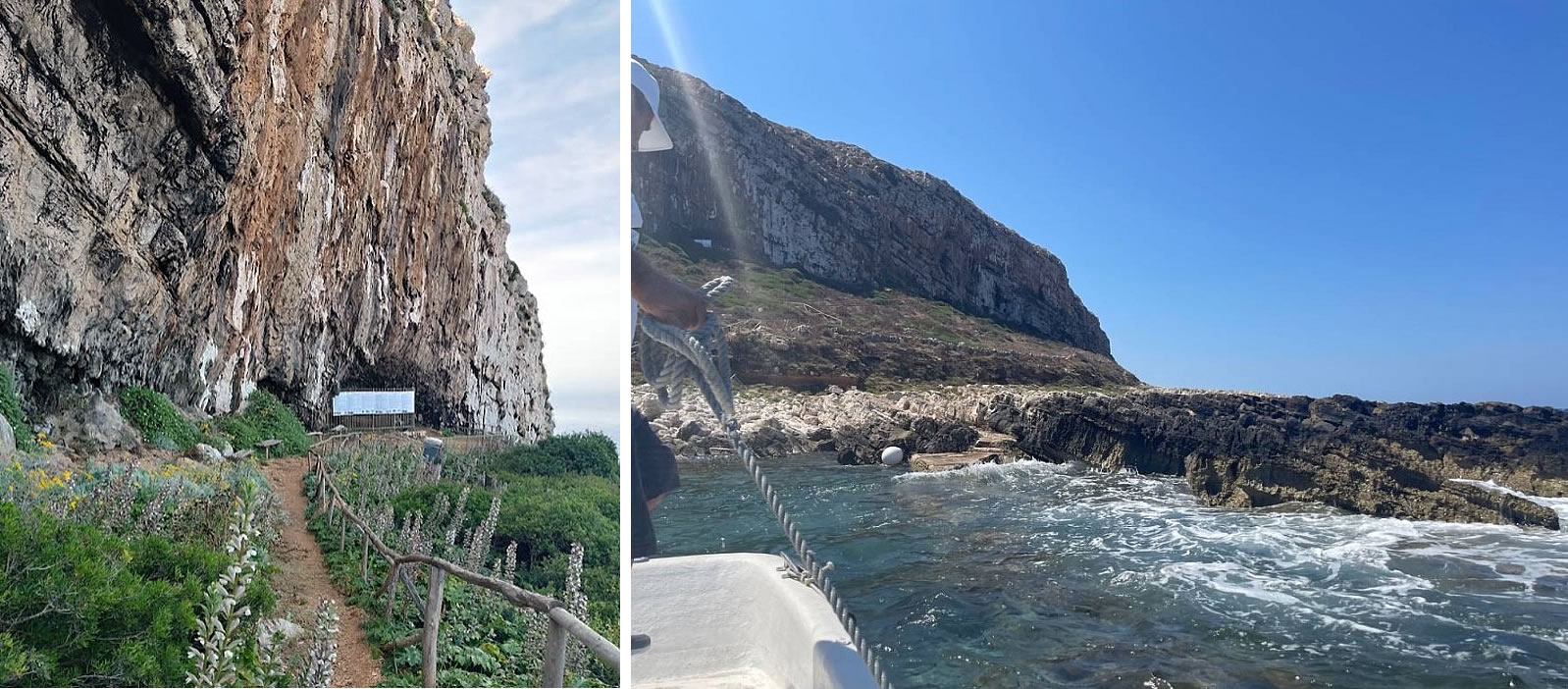
Genovese cave
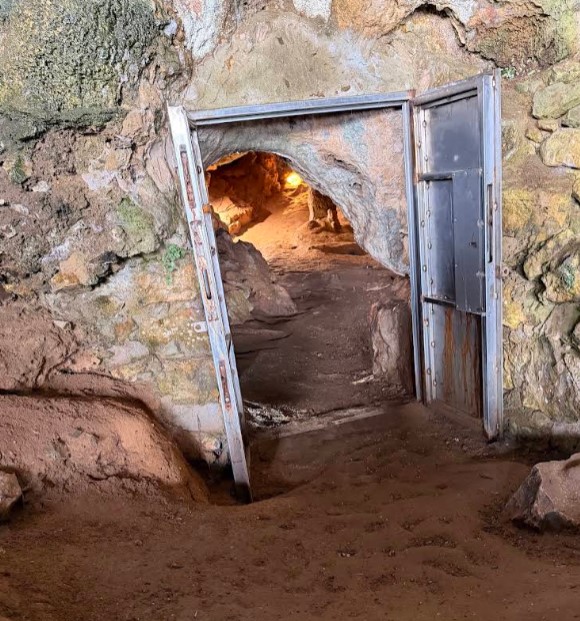
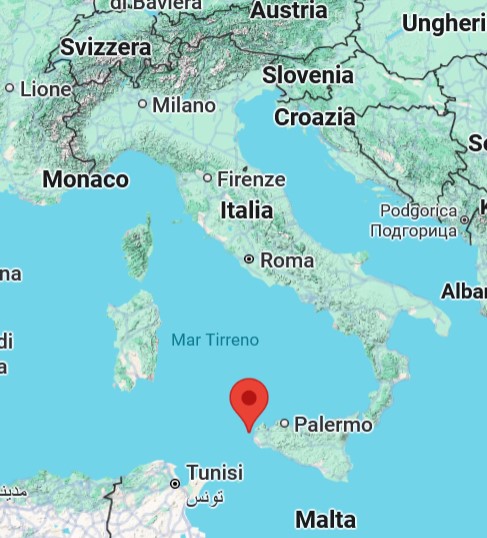
Levanzo is the northernmost islet of the Egadi archipelago, separated only by shallow seabeds from the northwestern coast of Sicily, to which it would have been connected during the Pleistocene epoch. On the southern coast of the island lies an inlet known as Cala del Genovese (or Cala Genovese), so named because it offered shelter to Genoese ships that, in past centuries (particularly in the eighteenth century), would anchor in this northwest-facing inlet to seek refuge from sirocco winds or to replenish their water supplies. Here, on a limestone wall, thirty metres above sea level and concealed by vegetation, opens a cave that was inhabited by humans during a period spanning from approximately 10,000 to 6,000 BCE. Until the beginning of the last century, however, the islanders knew of the cave but had never entered it; they would go there to hunt rabbits hiding inside, using ferrets to flush them out.
The Genovese cave preserves one of the most precious treasures of European prehistoric art: human and animal figures, both engraved and painted, dating to a period between the Paleolithic and the Neolithic. It is accessible either by boat or via a footpath.
The Genovese cave was explored in 1950 and has yielded evidence of Paleolithic art in Sicily, representing one of the most significant examples of late-glacial parietal art in the entire Mediterranean—a complex of Paleolithic rock art of considerable value that renders it a veritable "sanctuary." Two clearly distinct cycles, both artistically and chronologically, are found here: one engraved and the other painted.
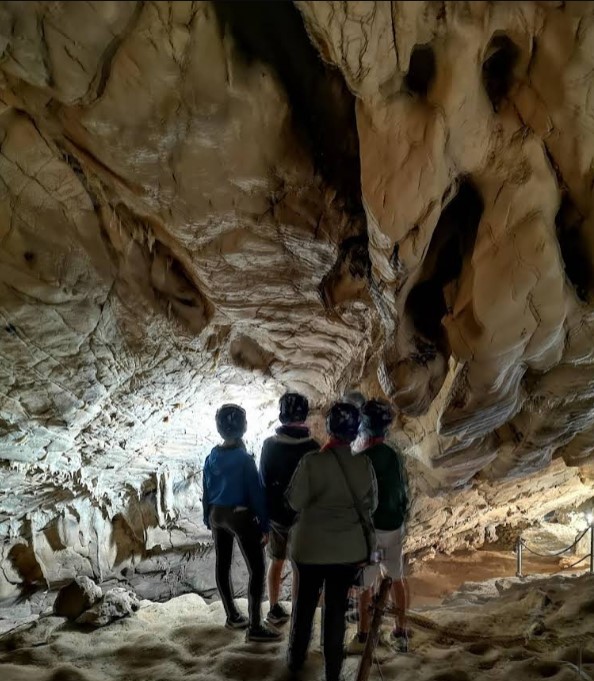
The cave comprises two chambers connected by a very narrow passage: a spacious entrance chamber (the antechamber), containing the remains of a lime kiln dating to the late medieval period; and an inner chamber, lower in height but longer (the inner recess), whose walls are decorated with two distinct series of figurations—the more ancient engraved and the more recent painted.
The Engravings
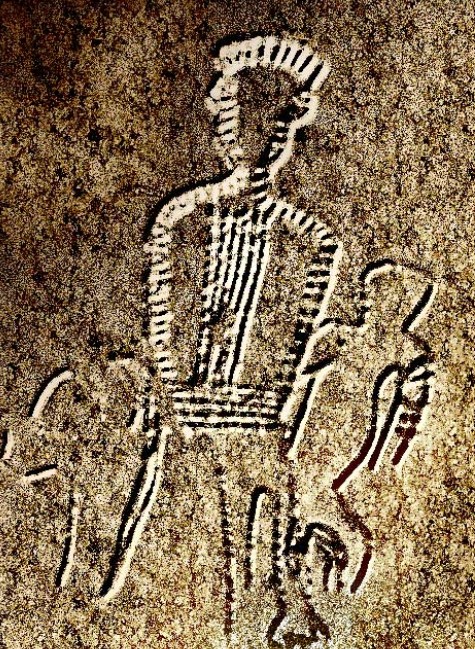
These predominantly depict large Quaternary mammals, such as Cervus elaphus, Bos primigenius, and Equus hydruntinus, although four human figures wearing bird-headed masks and headdresses similar to those found in the Addaura caves are also present. The engraving is executed with a uniform line that outlines the contours of the figures, omitting anatomical details while achieving effects of remarkable vivacity. A rock fragment, discovered sporadically within the cave and decorated with an engraved bovine, reiterates the motifs of the parietal graffiti.
Radiocarbon dating places the engravings at approximately 9,230 BCE, a period when Levanzo and the neighbouring island of Favignana were still connected to the mainland. This corresponds to the final phase of the Upper Paleolithic—that is, the transitional period from the Pleistocene to the Holocene geological epoch—when climatic changes resulting from the retreat of continental glaciers compelled human populations to adapt to an altered ecosystem and to adopt certain cultural changes that transformed them from simple hunters into hunter-fisher-foragers of molluscs.
The principal figure, dominating those of the animals which, from their posture, appear to be grazing, is that of a man clad in a tunic—apparently sewn and adorned with hanging fringes. On his head he wears a headdress of distinctive shape, elongated, wedge-shaped, and domed. Bracelets are clearly visible on his arms, and he is conspicuously motionless. Beside him are two other figures: one with a bird head or mask, perhaps in a dancing posture, and the other in motion, wearing a headdress similar to that of the central figure. It remains unclear whether this represents a ritual dance or a pre-hunting prayer.
The Paintings
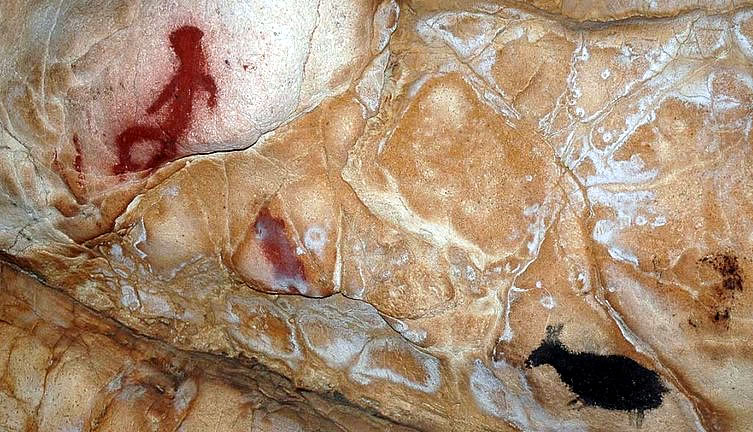
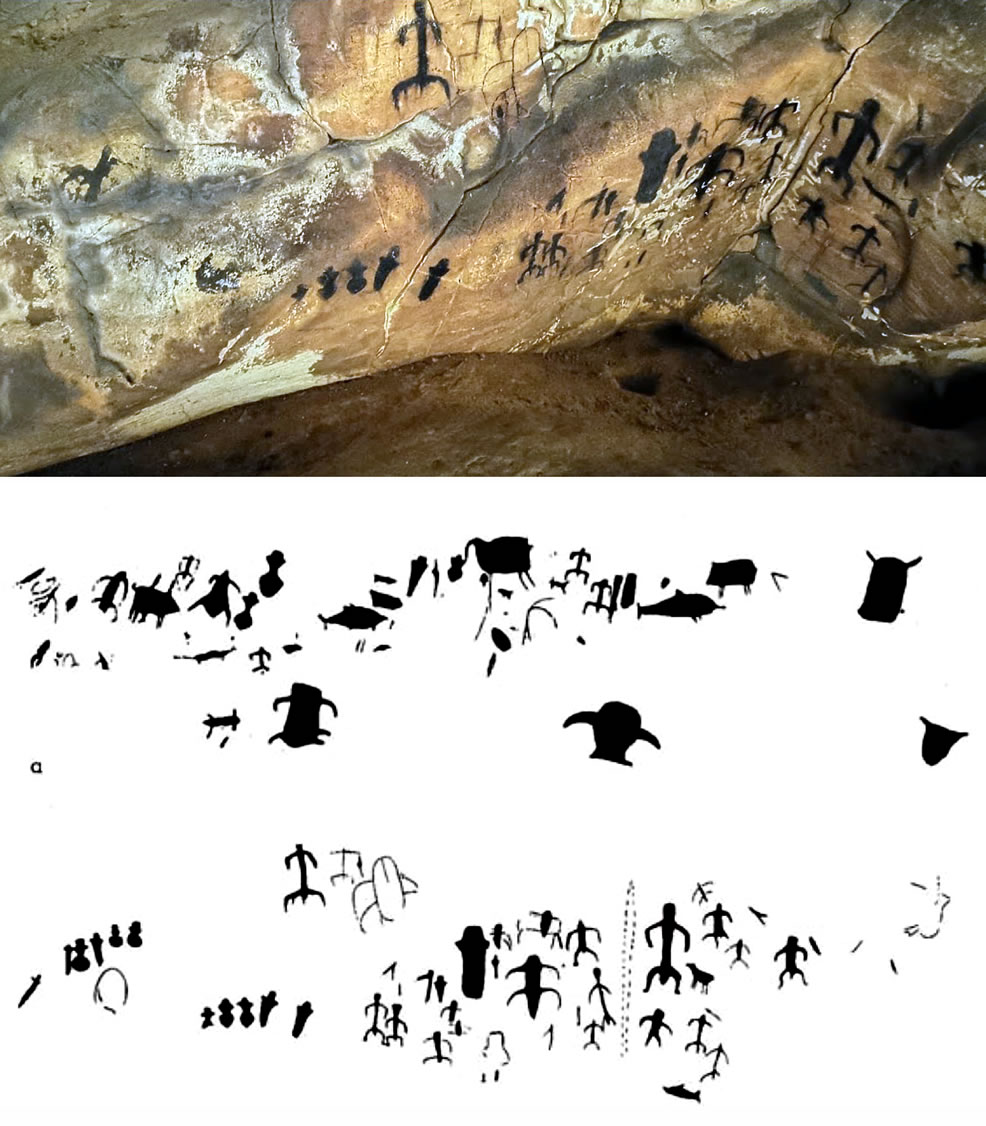
The paintings date to a later phase of occupation of the Genovese cave: 5,000–6,000 years ago, when the sea surrounded the islands of Levanzo and Favignana. The group of figures painted in black exhibits a rigid schematisation, now far removed from any vivacity, and approaches, in its anthropomorphic figures, the style of the clay idols of the Mediterranean Neolithic. A point of transition between the two series is offered by a group of three human figures, one perhaps dancing, executed in sgraffito but stylistically more rigid than the others treated in the same technique, and by a figure painted in red rather than black, yet stylistically closer to the vivacity of the engraved figures. Depicting a man with a sinuous body and wedge-shaped head, it is attributable to the Paleolithic period; indeed, it closely resembles the figure positioned on the right in the aforementioned dance scene and is therefore rightly considered contemporary with the engravings.
The paintings represent both male and female human figures alongside mammals and fish, including the tuna, which remains present to this day in the life and culture of the Egadi Islands. Particularly noteworthy are the fourteen painted idols found in the cave. Six of these are violin-shaped (a globular form with a swollen belly, a central constriction, and arms reduced to tiny appendages), while the remaining eight are cylindrical in form, with only barely indicated upper limbs, as also observed in the preceding six. The anthropomorphic painted representations of Levanzo are highly stylised: the body is almost invariably filiform, and the limbs are long and slender. In contrast, in some subjects the volume of the body increases exponentially, and the limbs shorten almost to the point of disappearing.