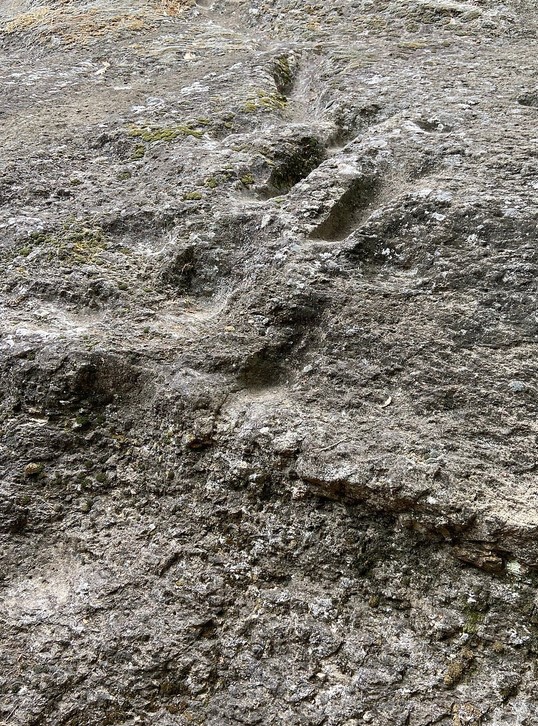
Who were the hominids that left their marks on the Roccamonfina volcano?

The Roccamonfina volcano, geologically speaking, is now extinct. It lies midway between the great volcanoes of the Rome area (the Alban Hills, Vico, and Bolsena) and those of the Naples area (Ischia, Procida, the Phlegraean Fields, and Somma-Vesuvius). Its eruptive life was extraordinarily long, spanning approximately one and a half million years, until about fifty-three thousand years ago.
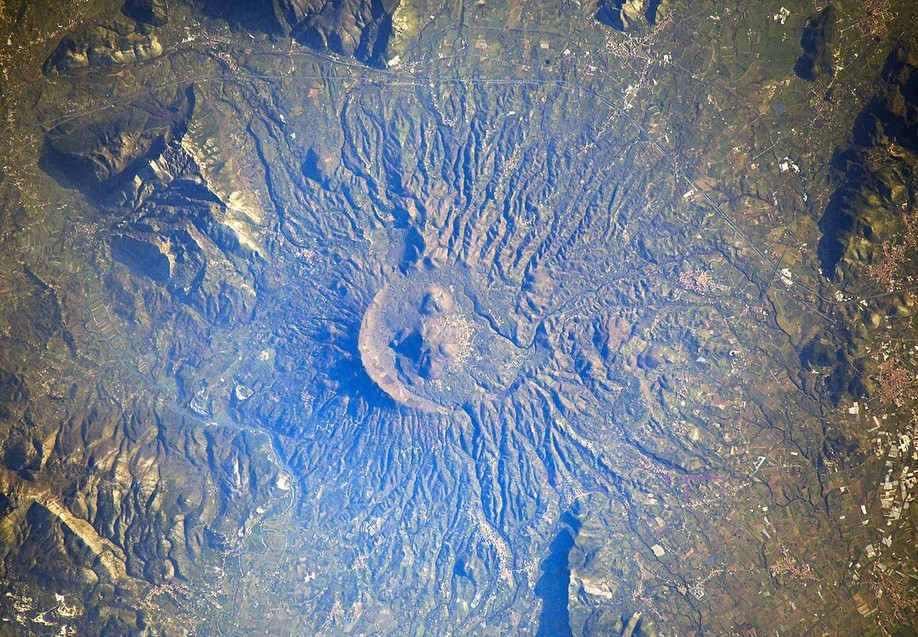
In its early stages, lava flows and less violent explosive eruptions built an imposing stratovolcano with extremely steep slopes. But it was in a later phase, between 385,000 and 230,000 years ago, that the volcano underwent its most dramatic transformations. Violent explosions caused its summit to collapse, forming a vast caldera and simultaneously generating massive pyroclastic flow deposits—those scorching clouds of gas and incandescent material that rank among nature's most destructive phenomena. The final activities, dating back to about fifty-three thousand years ago, were more modest and led to the formation within the caldera of characteristic volcanic domes, such as Monte Santa Croce and Monte Lattani, which are still clearly visible in the landscape today.
The material on which the Ciampate del Diavolo (Devil's Footprints) were impressed is the so-called Brown Leucitic Tuff, dated between 385,000 and 325,000 years ago. It is the product of a highly explosive eruption similar to the one that destroyed the Roman cities of Pompeii and Herculaneum in 79 AD. At the moment of deposition, this loose deposit of volcanic ash, lapilli, and pumice would have had a temperature of approximately 400°C.
As the temperature cooled and following the circulation of hot fluids, part of the deposit underwent intense alteration, forming secondary minerals (zeolites, chabazite, and phillipsite). During this phase, the deposit's temperature would have dropped to about 60–40°C. At that precise moment, the hominids who were fleeing passed by, leaving their footprints. The final consolidation of the deposit occurred shortly afterward, allowing us to still see today, after nearly 400,000 years, the oldest human footprints in the world.
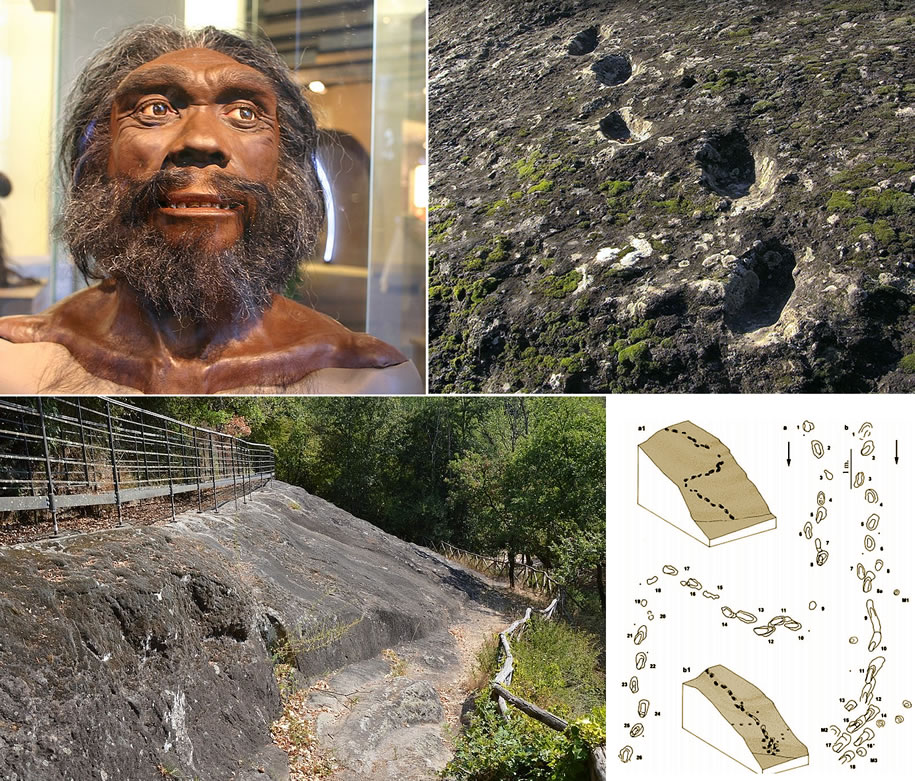
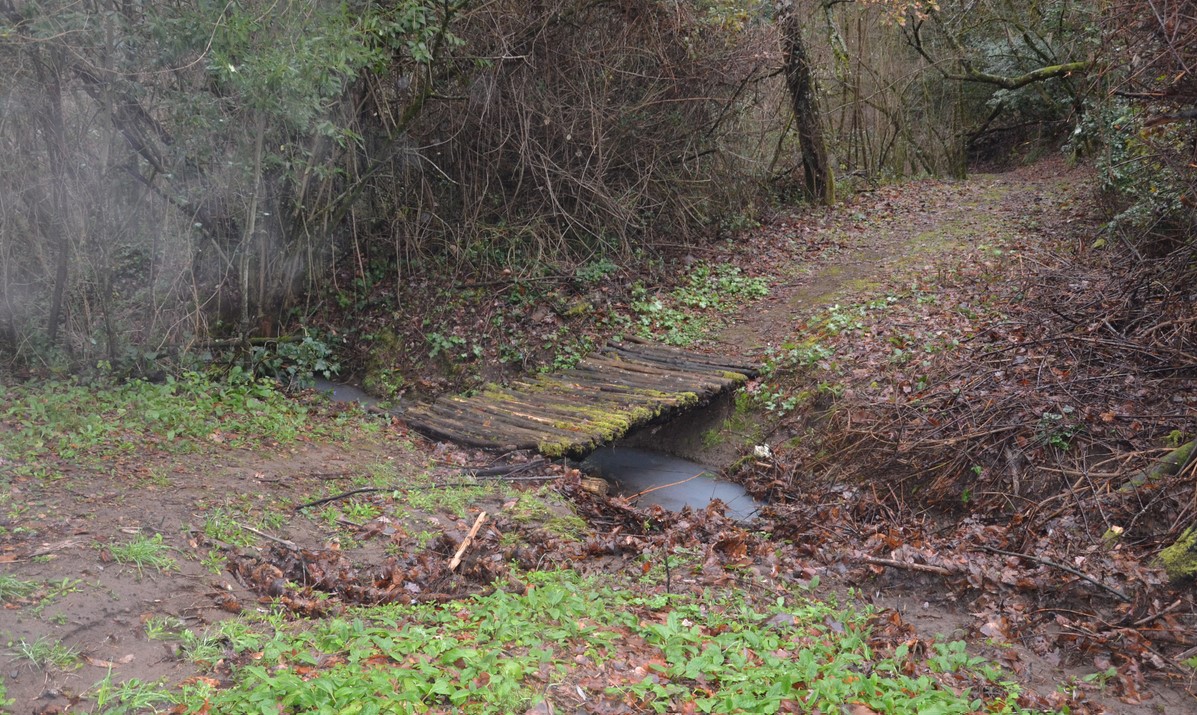
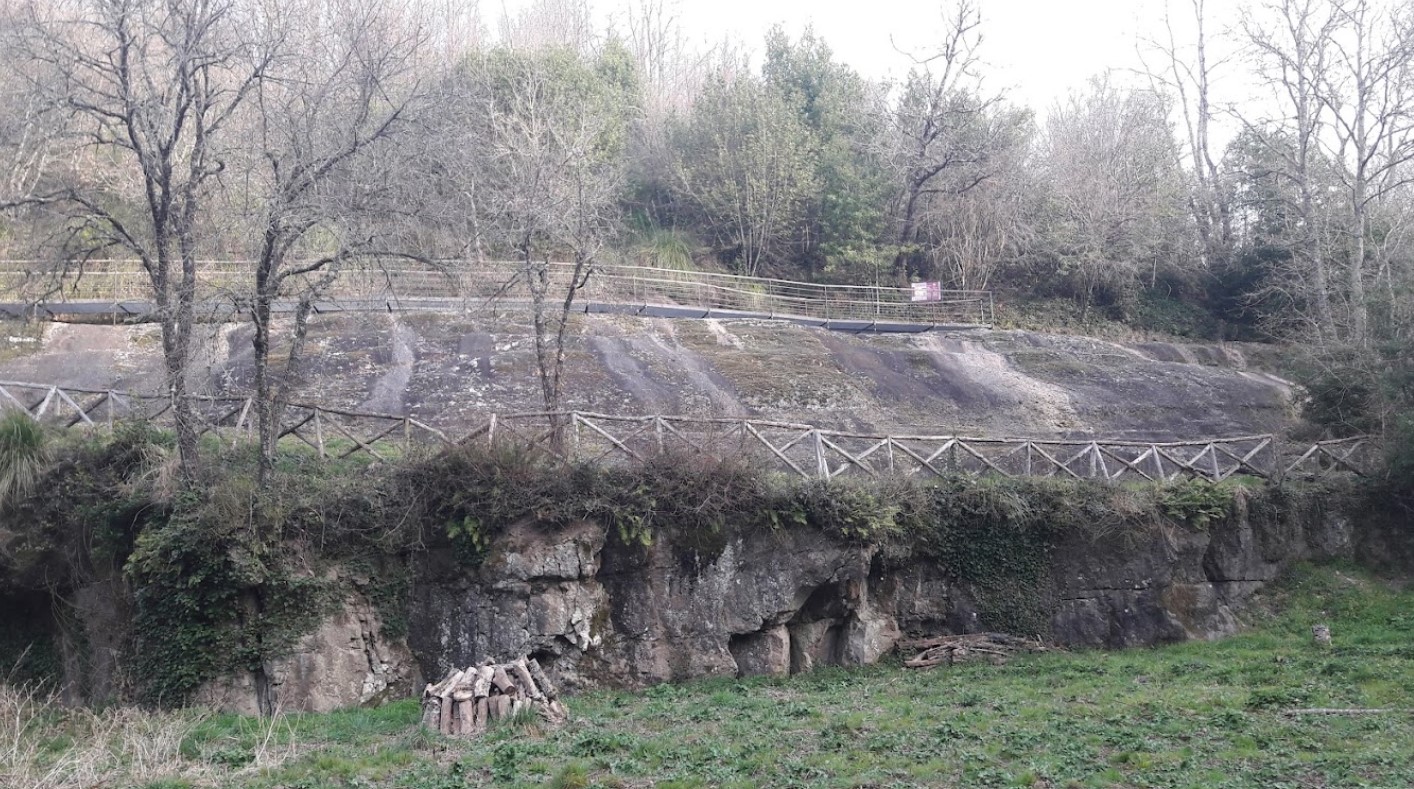
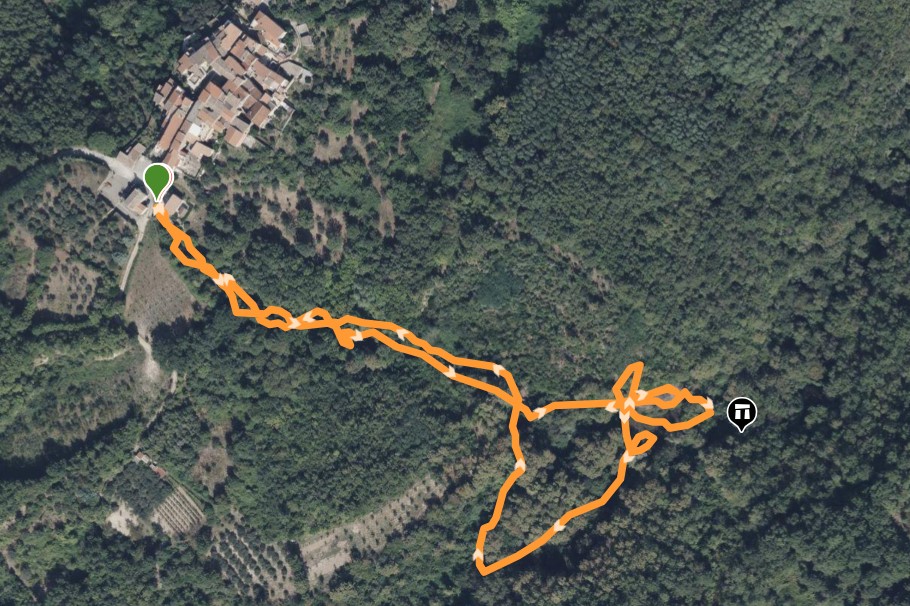
From the small square of the Foresta hamlet, in the municipality of Tora e Piccilli, past an iron gate and along a path through a small wood, one reaches a walkway that traces the oldest prehistoric path in the world walked by humans, overlooking a volcanic slope. Local folk tradition, always both fascinated and intimidated by these mysterious footprints, christened them the Devil's paw prints—because it was thought that only an infernal being could walk on still-hot lava without being burned. This name, besides carrying an air of mystery, likely also served as a warning to keep the curious away from a treacherous and dangerous place. Subsequently, the footprints were erroneously attributed to Italic populations from the protohistoric period. Only with the start of systematic archaeological investigations, beginning in 2001, did the truth finally come to light.
In that first excavation campaign, as many as fifty-six human footprints were documented, arranged in three sequences of steps, and animal tracks sharing the habitat with these ancient hominids were also discovered. The identity of those who left the traces was attributed to Homo heidelbergensis, a species that lived in the area about 350,000 years ago and is considered an ancestor of the Neanderthals. Dating, carried out using the argon-argon radiometric method, yielded an incredibly precise age: 349,000 years, with a margin of error of just 3,000 years. At the time of their official scientific publication in 2003 on the pages of the prestigious journal Nature, these footprints held the world record for antiquity for the genus Homo—a record surpassed only in 2013 by the discovery of the Happisburgh footprints in England.
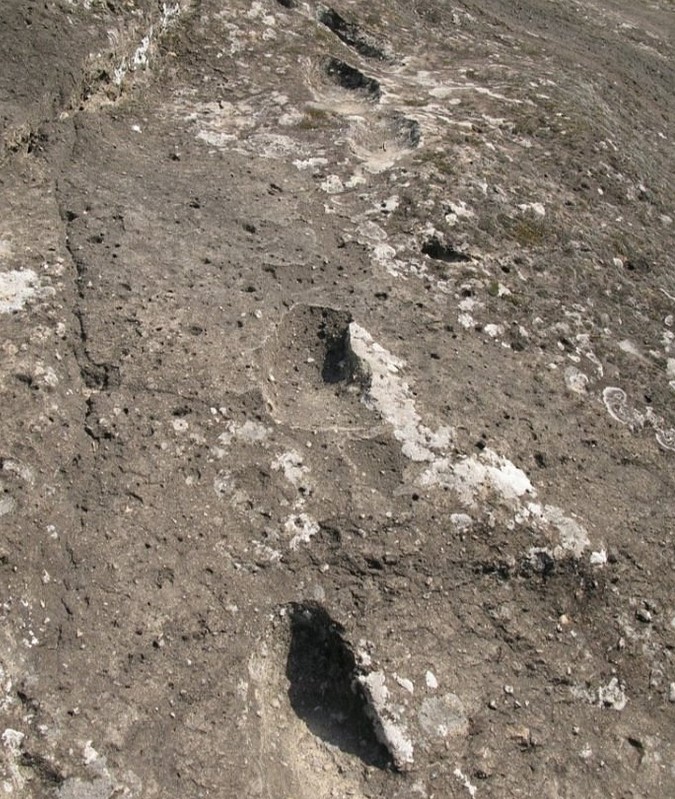
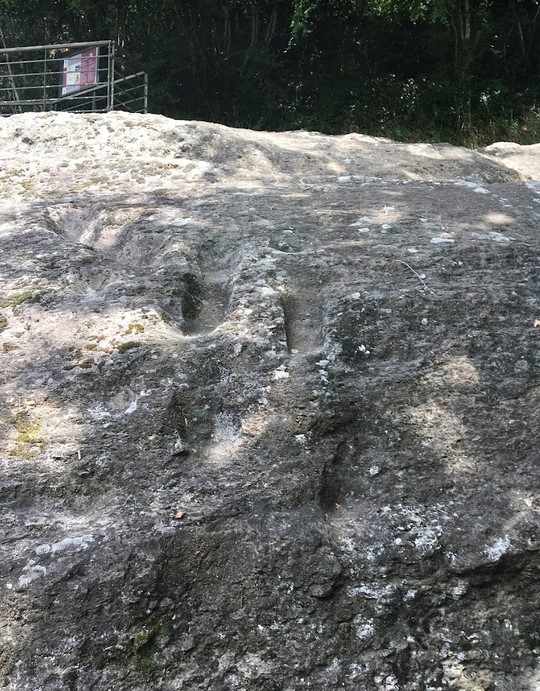
In 2005, an even greater number of footprints were brought to light—over a hundred—distributed across seven distinct trackways, revealing extraordinary details about the lives of these ancient ancestors. The footprints measure on average about ten centimeters wide by twenty centimeters long, a size roughly corresponding to a modern European shoe size 36 (US women's 5.5–6 / men's 4.5). Based on these dimensions, the height of the individuals has been estimated at about 160 centimeters (5'3"). Their shape is unmistakably human: from the impact zones, the forefoot, big toe, and plantar arch are clearly recognizable, and the alternating steps—with some tracks even showing cross-stepping movements—demonstrate beyond any doubt that these hominids were bipedal. Furthermore, the warm volcanic mud and the slope's inclination (up to 85%) contributed to creating a cast larger than the foot's actual size, which explains why the footprints sometimes appear larger and deeper than expected, and likely fueled the legend of a giant demon.
The arrangement of the footprints along this slope tells a story of descent and the remarkable adaptability of these ancient humans. The so-called Trackway A, the longest at thirteen meters and forty centimeters, consists of twenty-seven footprints (or twenty-six, according to some earlier surveys) that trace a clear zigzag trajectory—almost a large "Z" on the mountain's flank. This pattern is by no means accidental: the hominid who traveled that stretch adopted a rational strategy to tackle the steep gradient, moving diagonally and compensating for the descent to avoid slipping, exactly as we would do today under the same conditions.
Even more spectacular and unique in the world is Trackway B, measuring eight meters and sixty centimeters with nineteen footprints, which seems to tell a scene of great tension. After a short straight section, the hominid walking along it was suddenly caught off guard by the ground giving way beneath their feet. As they slipped, losing their balance, to keep from falling they braced themselves with their left side against the slope, impressing into the soft mud not only their feet but also their left wrist and hand in a desperate attempt to stop the slide. In that movement, while trying to regain stability, they also left impressions of their calves and ankles in the ground. This is a fossilized event that has preserved anatomical parts of the human body never before documented at any other site in the world, except in rare ritual contexts from much later periods, making this trackway an absolute unicum in the international scientific landscape.
But perhaps the most surprising element of the entire Devil's Footprints site is another one, concerning the discovery of an actual prehistoric path. At the beginning of the ledge overlooking the slope, a wide area presents three deep grooves with a sinuous course, eventually converging into a single track. Human footprints have been found within these grooves, and their analysis has revealed that they are ancient routes that were repeatedly trodden over time, evidence of prolonged use. What makes this path even more extraordinary is that our ancestors did not merely walk it but actively modified it, transforming some sections into channels for rainwater runoff or into stepped tiers to make walking safer, especially in wet conditions when the tuff surface became slippery. This ancient route, which led from the area called Parata Nova to Foresta, is a unique example of persistence: the very same path, with its three parallel tracks, is still marked on both official and historical topographic maps today, demonstrating that human settlement choices and routes can endure uninterrupted for hundreds of thousands of years when strongly constrained by the morphology of the terrain. This makes the Devil's Footprints not only the oldest known fossilized human path but also the longest-lasting evidence of continuity in human movement across a territory.
The site of Tora e Piccilli, with all its footprints and fossilized paths, thus confirms itself as one of the most important human paleontological sites on our planet. Every footprint, every trackway, and every groove tells a fragment of the lives of a group of Homo heidelbergensis who, 350,000 years ago, moved with intelligence and effort along a volcanic slope—and whose story, thanks to a unique convergence of geological circumstances, has reached us still vivid and ready to be studied.