Was the Savignano Venus a Ground-Inserted Fertility Idol?

In the artistic production of the Upper Paleolithic, two principal categories of artifacts are distinguished: parietal or rock art, which encompasses engravings and paintings executed on cave walls, and portable art, which includes ornamental objects and sculptures, particularly those in the round. This latter sculptural typology is characterized by a volume and form that are autonomous with respect to the surrounding space, thereby differentiating it from bas-relief and high-relief. Throughout the initial phase of the Upper Paleolithic, sculpture in the round is devoted almost exclusively to the representation of the human body and, more specifically, to the female figure, with a marked accentuation of certain morphological features. Paleolithic anthropomorphic production reaches its apogee during this period, whereas in subsequent phases, with rare exceptions, stylized animal representations predominate.
Human figures are comparatively rare in Paleolithic art; a significant exception is constituted by the so-called Venuses or Great Mothers. These are statuettes carved in stone or mammoth ivory, notable for their technical sophistication and the profound realism they occasionally exhibit. They depict a female type characterized by recurrent somatic traits: abundant adipose masses, highly developed breasts, and, in some instances, a considerable accumulation of fat in the gluteal region. The lower extremities, devoid of feet, terminate in a point, while the arms, slender and barely outlined, are often folded across the chest. The face is not defined in detail, sometimes obscured by thick hair, and the body is rendered in a conventionalized manner.
The use of the term "Venuses," introduced by early palethnologists, reflected the hypothesis that such representations embodied the female aesthetic ideal of the era; in reality, they do not constitute realistic depictions but rather probably intentionally distorted amulets, linked to practices of propitiation of female fertility and, where inserted into the ground, also of the fertility of the earth—a circumstance that would explain the pointed shape of the head of some specimens.
For the execution of these prehistoric sculptures, stone, horn, bone, and ivory were primarily employed, while the use of amber and steatite is rarer. The tools for carving, in the absence of metals, were initially fashioned from particularly hard stones; pointed implements of stone or bone were likely also used to incise figures on rock or clay surfaces.
Paleolithic Venuses have been discovered across an extensive geographical area, from the Atlantic coasts to Siberia, and present dimensions varying from 2–3 cm up to over 14 cm. Notwithstanding regional stylistic differences, they share certain common traits: small dimensions and the accentuation of secondary sexual characteristics, which suggest a function as fertility idollets, probably connected to magico-religious rituals. The limbs are generally barely indicated or entirely absent, transformed into elongated protuberances, which has led to the hypothesis that they could have been inserted into the ground. Initially, it was thought that such artifacts served to propitiate the harvest or the continuity of the species; however, their discovery in sacred contexts with a templar function has directed scholars toward an association with the cult of the mother-goddess. The finding of some statuettes inside huts and near hearths, almost as if they were protective idols of domestic life, has also suggested a possible link with ancestor worship, in which fertility constituted a primary value within the sphere of familial and tribal sacredness.
The Great Mother, or Great Goddess, constitutes a primordial divine figure attested in various cultures from the Paleolithic onward, with continuity into the Neolithic, involving both hunter-gatherer societies and agricultural and pastoral civilizations. She manifests both in concrete anthropomorphic goddesses and in a multiplicity of symbols encompassing the animal and inanimate worlds. The female figure embodies the cycle of birth, development, maturity, decline, death, and regeneration that characterizes both human existences and natural and cosmic cycles, thus representing a bridge between the human and the divine. This intersection between mythology and cosmology covers an extended temporal arc, approximately from 35,000 to 2000 BCE.
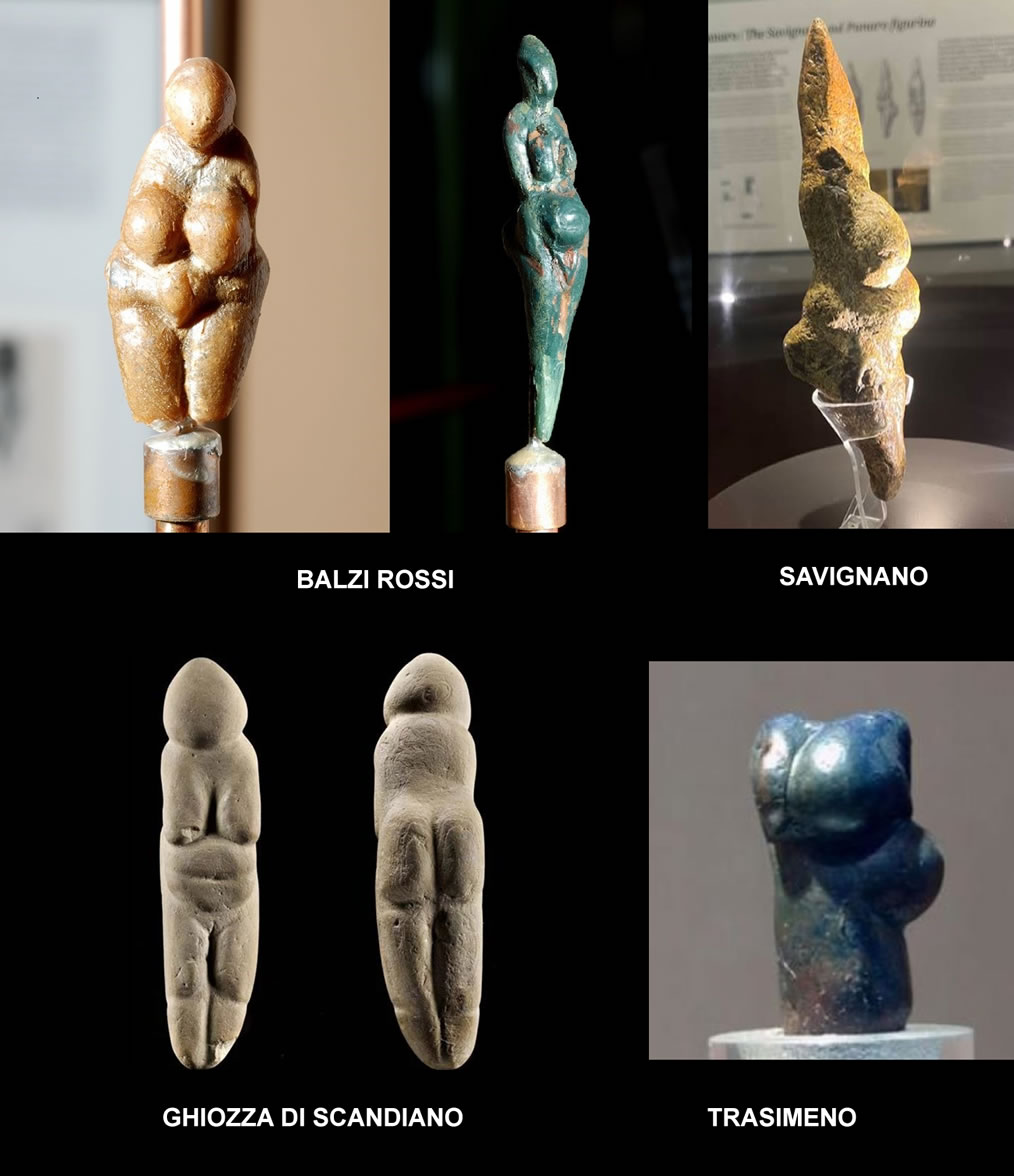
In Italy, several specimens have been discovered, including the celebrated Venuses of the Balzi Rossi (Ventimiglia) and that of Savignano (Modena). Less renowned are the Venere del Trasimeno and an interesting stone specimen, recovered under uncertain stratigraphic conditions at Ghiozza di Scandiano (Reggio Emilia). Of the former, it is known only that it is a small female statuette in the round, missing the lower portion from the abdomen downward due to an ancient break, found in the late 19th century, carved in steatite, originating from an unspecified locality west of Lake Trasimeno (Perugia) within a radius of approximately 15 km from the present shoreline. Of the latter, it is known that it was found in 1940 in the Alboni quarries of Chiozza di Scandiano, near Reggio Emilia, among the pebbles that the quarry workers discarded on the edges of the pits in order to collect only pure clay destined for the manufacture of bricks in the adjacent kiln. The Venus was carved on a fluvial pebble of fine-grained yellowish sandstone, a rock common in our Apennines. Originally attributed stylistically to the Upper Paleolithic, it was subsequently assigned to the Neolithic with reference to the nearby Neolithic settlement identified along the Secchia River. A further hypothesis is that the statuette was located at the site as a secondary deposition, that is, that the artifact, originating from older deposits, had been reused as an amulet or funerary equipment, which, moreover, does not represent an isolated case. Stone artifacts of this type begin to appear in Europe from the beginning of the Upper Paleolithic (approximately 40–35,000 years ago) and continued to be produced until the conclusion of the Würm glaciation (approximately 12–10,000 years ago). This Venus, found out of context, is difficult to date, but if one takes into account the scant importance given to steatopygia in its execution, it may belong to one of the later phases of this period.
Savignano Venus
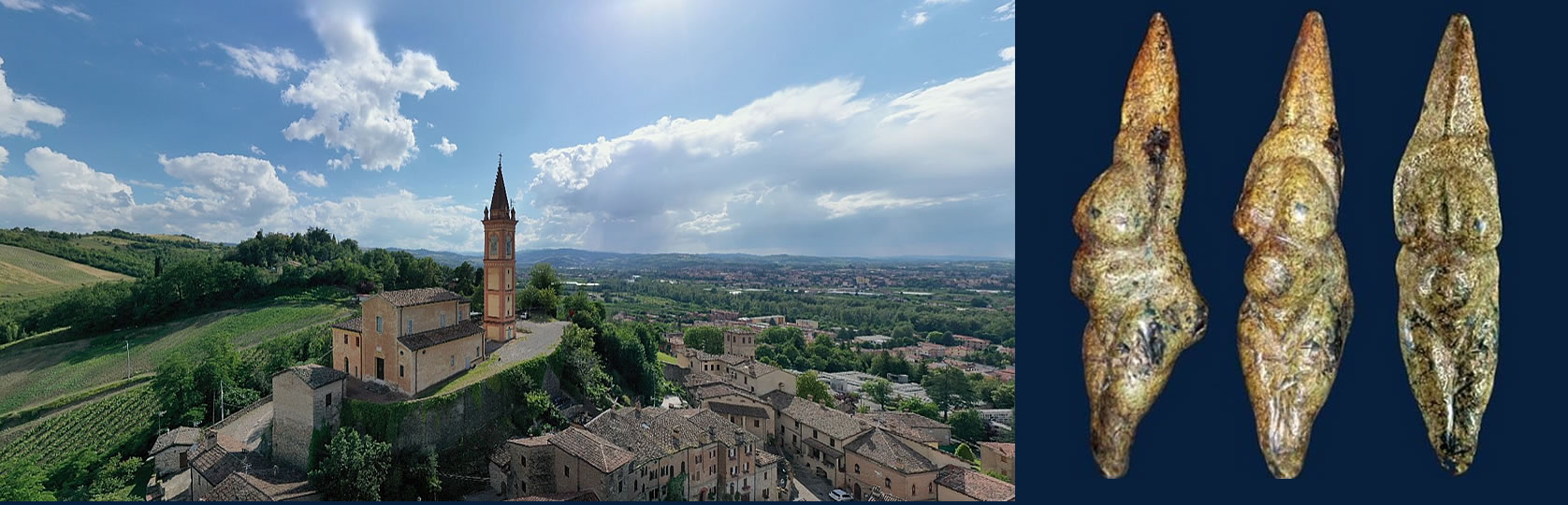
Among the specimens of greatest artistic significance is the Venere di Savignano, considered one of the masterpieces of Paleolithic anthropomorphic sculpture for its excellent workmanship and excellent state of preservation. With a height of 22 cm, it exceeds the dimensions of the majority of other statuettes. Its dating, though uncertain, is placed between 29,000 and 20,000 years ago, presumably within the Gravettian culture, alongside other celebrated Italian finds such as those of the Woman of Paglicci, Woman of Caviglione, Woman of Ostuni, and the so-called Prince of Arene Candide.
The statuette is carved from serpentinite, a soft stone common in the Modenese Apennines, and testifies to the capacity to represent the female body as early as approximately 25,000 years ago. Although it fits within the broader corpus of European Paleolithic Venuses, its symbolic meaning remains largely uncertain. It presents the typical traits of prehistoric Venuses, with local stylistic peculiarities that impart to the Emiliani specimens a spindle-shaped form, with conical extremities corresponding to the head and legs. Specifically, the Venere di Savignano shows legs joined and lacking feet, full and pendulous breasts, barely suggested arms folded over the chest, and rounded abdomen and buttocks. The whole presents a spindle-shaped aspect and a slight yellowish patina, probably due to superficial oxidation caused by clayey-ferruginous soil infiltrations. Traces of working (rough-hewing, pecking, smoothing, and polishing) are visible, and, on the left side and on the right arm, residues of red ochre. No additional decorations are observable, except for a double bilateral longitudinal incision: one continues on the anterior face to indicate the vulva, the other on the dorsal side to delineate the buttocks.
The artifact was discovered in 1925 in the locality of Prà Martin di Savignano sul Panaro, during excavations for the foundations of a rural building, at a depth between 120 and 140 cm from the ground surface. The absence of signs of fluvial transport suggests that the place of discovery corresponds to that of original deposition. Initially interpreted as an ancient weapon due to its pointed shape, the artifact was recognized as a sculpture by the sculptor Giuseppe Graziosi, who obtained the find in exchange for two quintals of grapes. Having traveled to Rome for consultation with the director of the Royal National Prehistoric Ethnographic Museum (now MUCIV – Museo delle Civiltà), Graziosi understood its international importance and facilitated its entry into the collections of the institution, established with the aim of conferring a unitary scientific framework to palethnological studies in Italy. Subsequent excavations conducted at the same site did not clarify the problem of the chronological attribution of the artifact, which was assigned to the Upper Paleolithic on purely stylistic grounds. Although some authors, both in the past and more recently, have proposed a Neolithic dating, the most accredited interpretation remains that which places the statuette in the Upper Paleolithic.