Did Australopithecus reach Europe before Homo erectus?
An anthropomorphic ape.
The long evolutionary path that led to humankind took place almost entirely in central and southern Africa. It was a complex and extraordinarily slow process. A turning point came over 4 million years ago with the appearance of Australopithecus. In the subsequent course of its evolution, several species emerged, nearly all of which became extinct around 1 million years ago. The only descendants of Australopithecus that did not die out belong to the genus Homo (Homo sapiens sapiens).
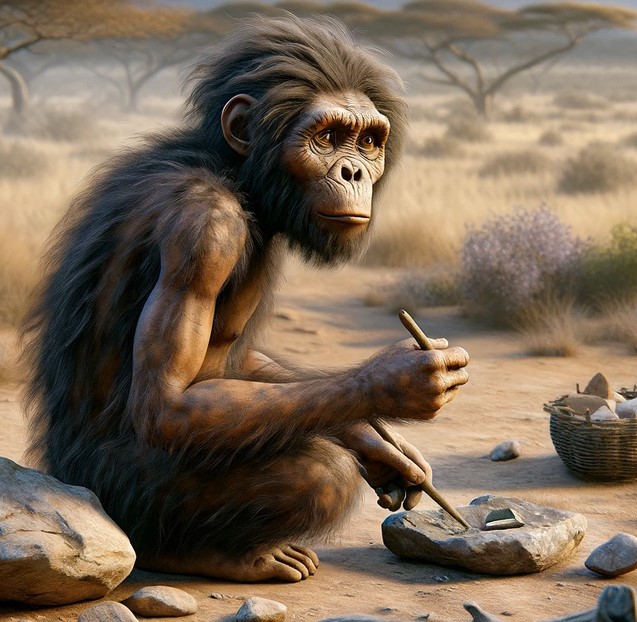
Australopithecus was an anthropomorphic ape, that is to say, of a "form" similar to humans, like chimpanzees and gorillas. It, however, was different from these apes because it had a vertebral column, limbs, and ribcage suited to an upright posture. In other words, it often stood upright and tended to move around while limiting the use of its forelimbs, unlike gorillas and chimpanzees, which are quadrupeds and use their knuckles as a support point for their forelimbs.
It was small in stature compared to humans, measuring between 1 and 1.5 meters in height and weighing 35–45 kg. It had a small brain, with a volume of about 400–450 ml. Its foot was not yet exclusively adapted for bipedal locomotion, although it did allow for upright walking. It spent most of its time in trees and was capable of making crude choppers—stone tools flaked on one side only (known as unifacial tools), creating a sharp cutting edge that could be used on various materials and for stripping meat from animal carcasses. In this respect, it was much like Homo habilis, with which it coexisted. This is confirmed by the discovery of lithic tools dated between 2.6 and 2.4 million years ago at certain Ethiopian sites—Kada Gona and Kada Hadar—near the Awash Valley.
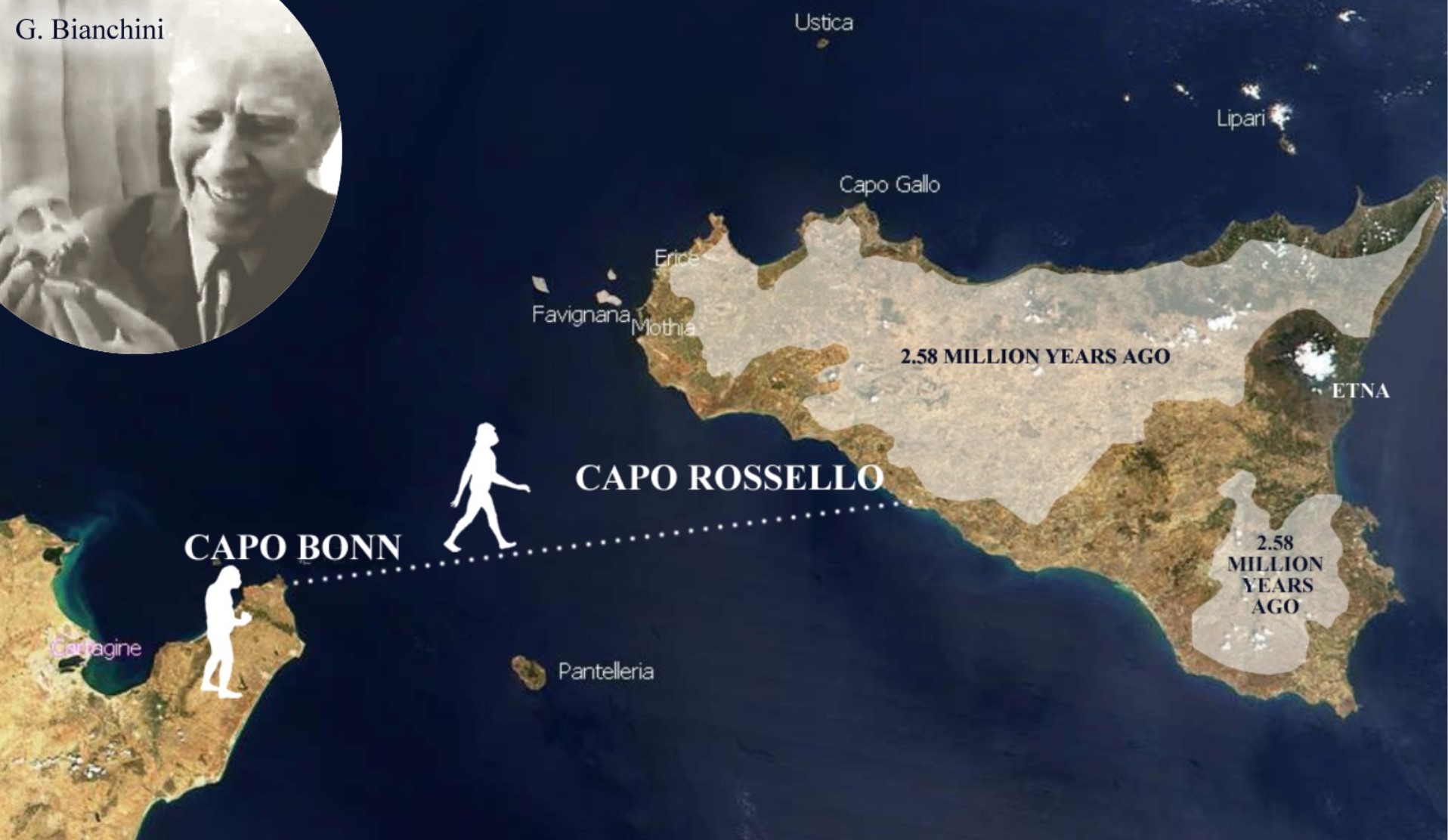
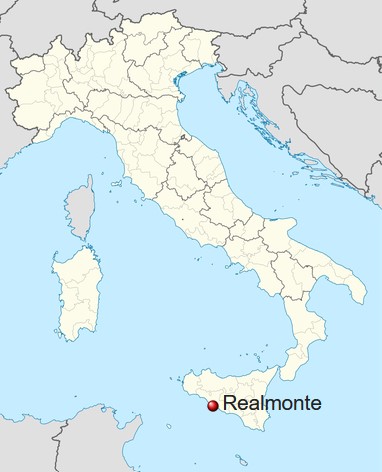
The earliest evidence of human presence on the Italian peninsula dates back to the Lower Paleolithic period (from roughly 2.5 million to about 120,000 years ago)—consider, for instance, the site at Capo Rossello in Realmonte, Sicily. There, around the 1960s, on the promontory where the lighthouse now stands, Gerlando Bianchini (a banker passionate about anthropology) discovered teeth and skull fragments belonging to an australopithecine of the Africanus or Gracilis type, along with coarse flint flake tools, some worked on one side, others on both. The pebbles, also made of flint, were shaped into large flakes—some very sharp, others cruder—typical of the Pebble Culture, that is, human settlements dedicated to producing tools from chipped pebbles, dating back to the Calabrian stage and considered the oldest workshops in Europe.
Australopithecus represents one of the first significant steps in human evolutionary history, and we have always placed it within the forests and savannas of Africa—for instance, in Ethiopia, where its earliest traces have been found. It was there, in 1974 at Hadar, Ethiopia, that the remains of Australopithecus afarensis, known as "Lucy," were unearthed, dating back to approximately 3.18 million years ago.
How and when did Australopithecus siculus reach Europe?
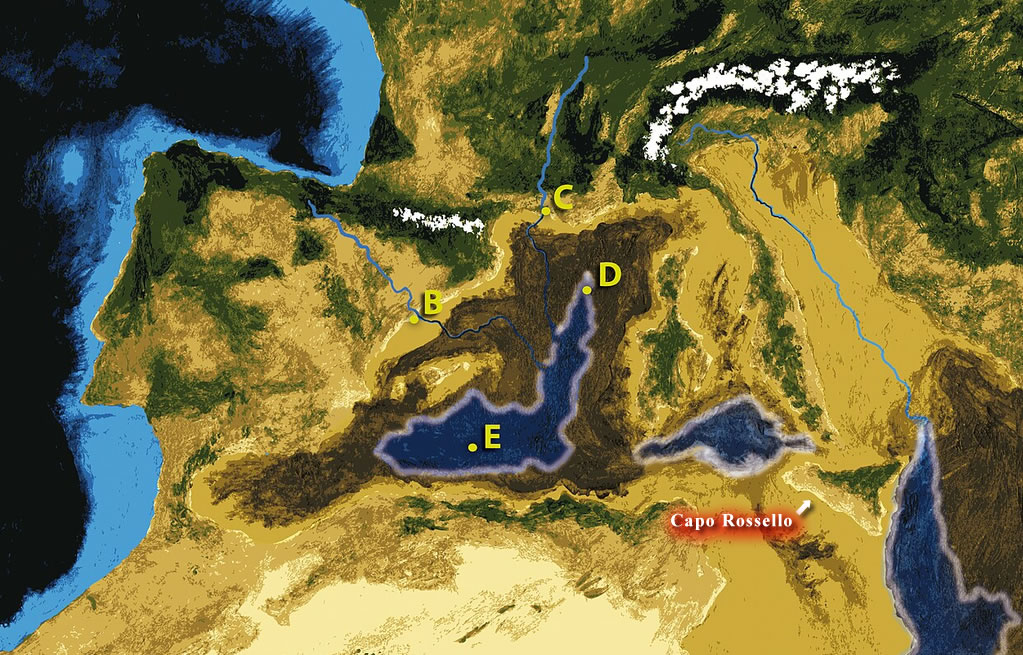
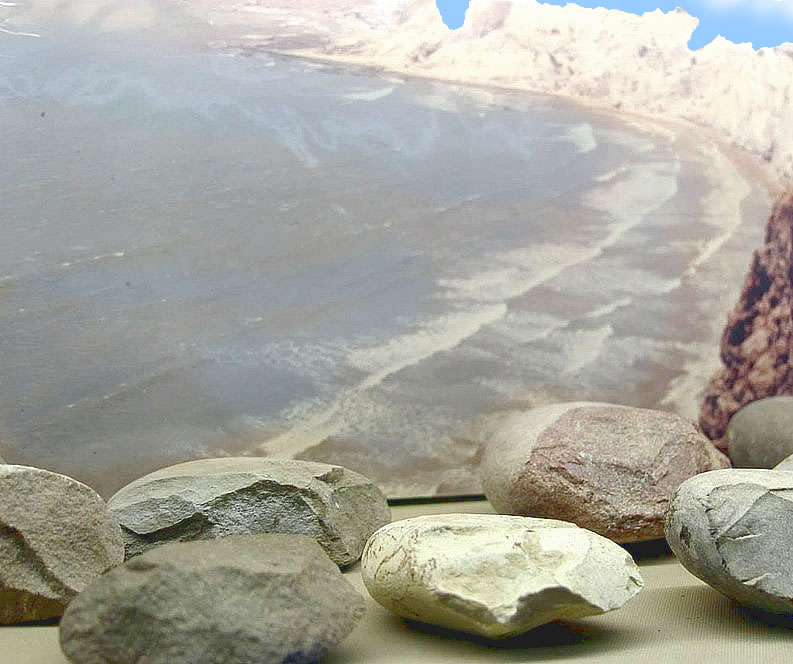
Most scholars agree that the human genus reached Europe following a trajectory from Africa to Eurasia to Sicily. However, considering that hominids were present in Africa as early as 5 to 6 million years ago, and taking into account that the Mediterranean Sea underwent significant sea-level drops at various times, it would not be entirely rash to hypothesize that a group of ancient African hominids might have reached Sicily directly. If not through a direct land connection, it is plausible that they followed an alternative route, passing from Morocco to Spain and then moving toward Sicily (Africa → Europe → Sicily). During that period, the absence or reduction of the Mediterranean—due to the so-called Messinian salinity crisis (video) —would have made the crossing easier, allowing them to traverse the basin on foot.
This geological event occurred during the final part of the Messinian stage of the Miocene (over 5 million years ago), during which the waters of the Mediterranean nearly completely evaporated owing to the closure of the Strait of Gibraltar. Around 5.9 million years ago, in the late Miocene, the precursor to today's Strait of Gibraltar closed, causing the Mediterranean to evaporate and turn into a largely dry, deep basin, whose floor in some areas reached 3.2–4.9 km below ocean level. It remained completely isolated from the Atlantic Ocean from 5.59 to 5.33 million years ago. The Mediterranean area was thus subjected to cyclical phases of desiccation and flooding for about 700,000 years. Then, around 5.4 million years ago, at the beginning of the Pliocene, the sill corresponding to the present-day Strait of Gibraltar reopened permanently, leading to the refilling of the Mediterranean basin.
Bianchini's discovery was met with skepticism by the scientific community. However, were the reliability of these finds to be definitively accepted, the discovery could be seen as further evidence supporting the idea that the human genus—even if in the form of early hominids—radiated from Africa directly into Europe. Some authors have hypothesized the existence of land bridges or, at least, archipelagos of closely spaced islands that could have allowed, during various phases of the Lower Pleistocene (2.58 million – 900,000 years ago) and Middle Pleistocene (900,000 – 455,000 years ago), a connection—albeit indirect—between the coasts of North Africa and the European continent across the Strait of Gibraltar or the Sicily Channel, thereby enabling the passage of fauna and hominids between the two continents. According to some scholars, there originally existed an isthmus connecting part of the coast of the province of Agrigento to Cap Bon in Tunisia.